Networks
A NetDefense network is a WireGuard overlay that turns several devices into a routable mesh. You choose an overlay CIDR, mark devices as HUB or SPOKE, and NetDefense generates the WireGuard configuration for every member during the next sync. Read the concept overview in VPN Networks.
Networks list
Section titled “Networks list”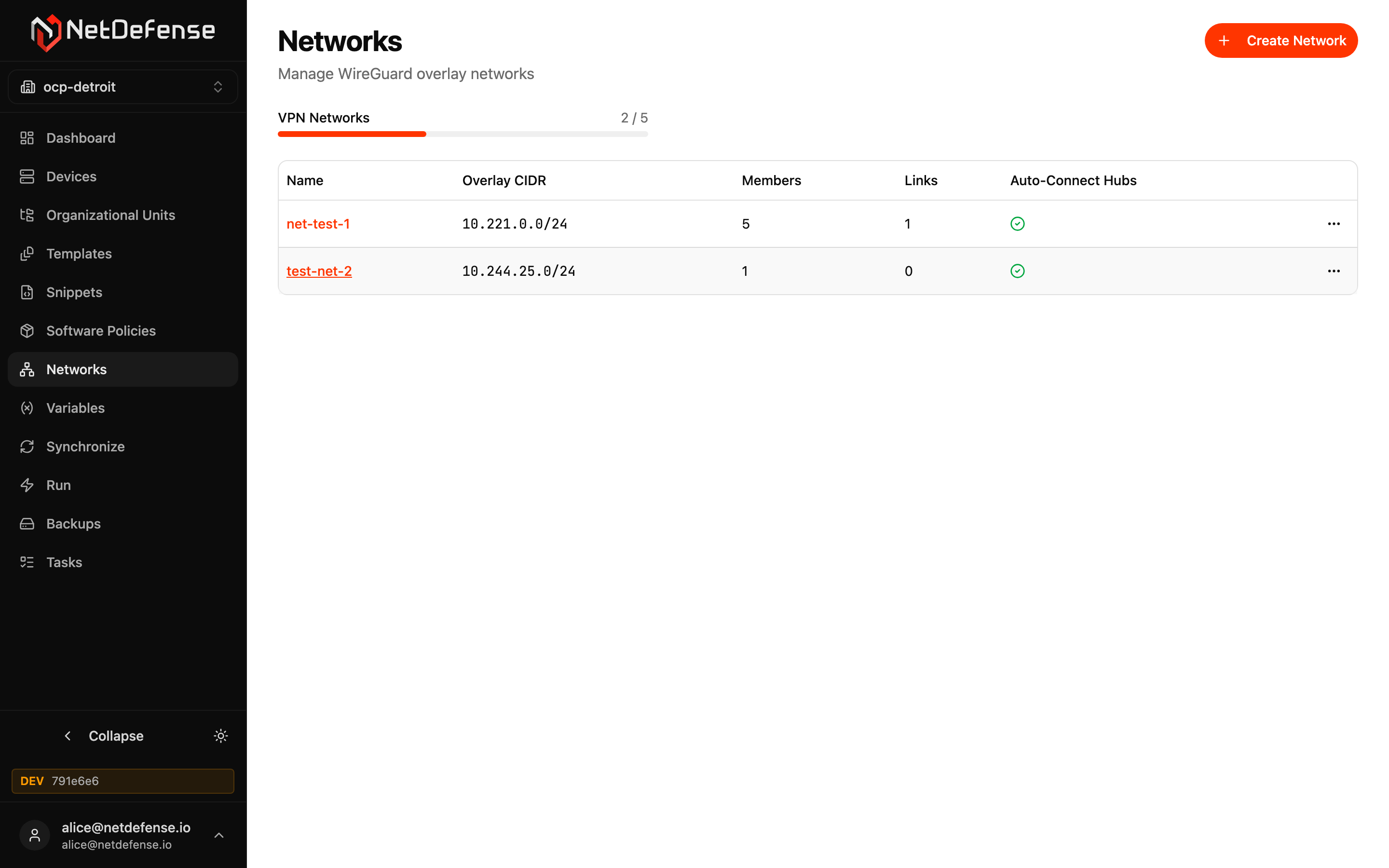
Each row is one overlay network:
| Column | Meaning |
|---|---|
| Name | Click to open the network. |
| Overlay CIDR | The private subnet WireGuard hands out to peers. Immutable after creation. |
| Members | How many devices are joined. |
| Links | How many explicit peer-to-peer links are defined (in addition to auto-connect). |
| Auto-Connect Hubs | Green check if HUBs auto-mesh with each other. |
A progress bar above the table shows your plan’s network-count quota (e.g. 2 / 5). Each row’s … menu has Settings, Sync members, and Delete.
Create a network
Section titled “Create a network”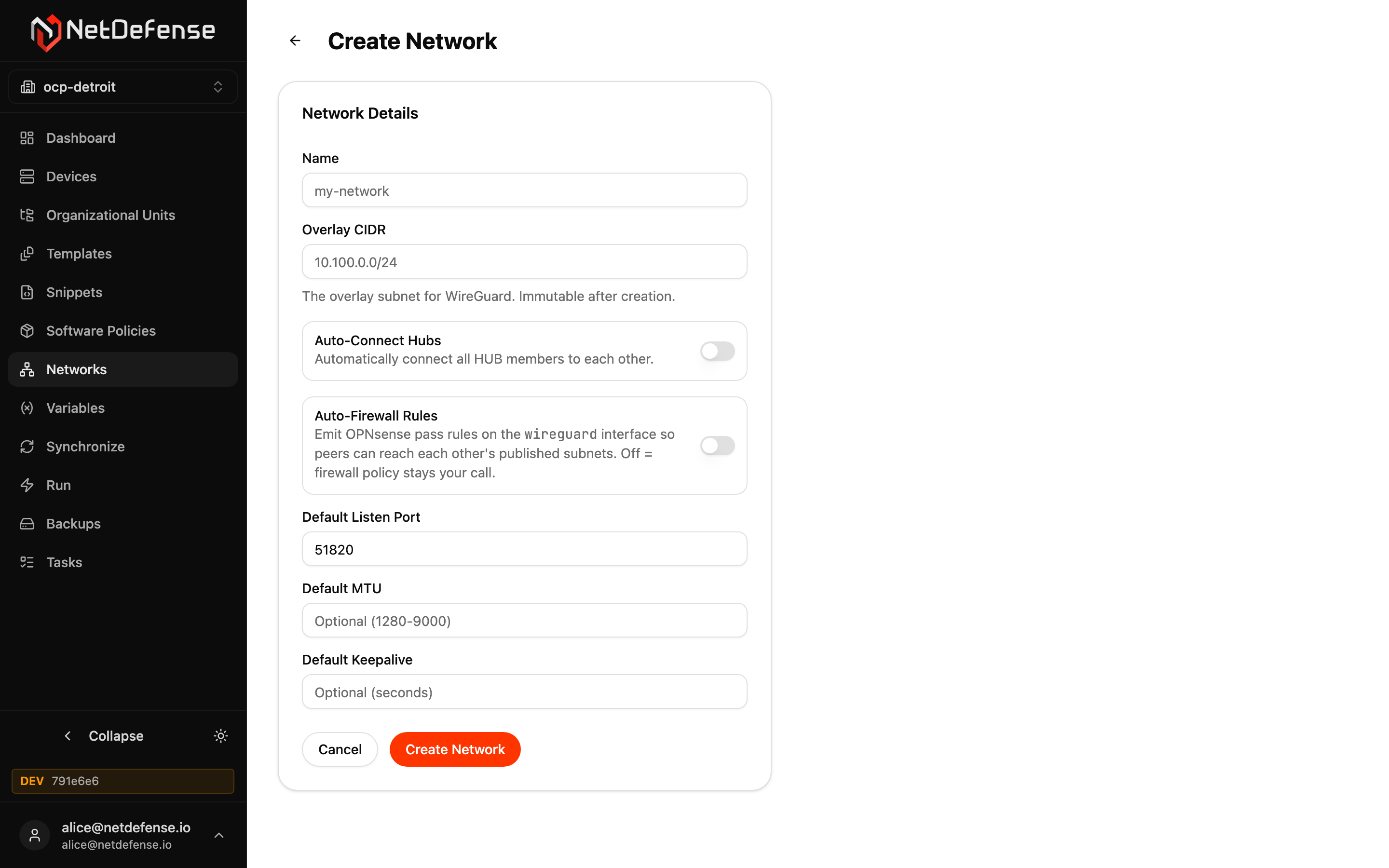
+ Create Network opens the form. Required fields:
- Name — used in URLs and on the device.
- Overlay CIDR — the WireGuard subnet. Cannot be changed later.
Optional:
- Auto-Connect Hubs — when on, every HUB member automatically peers with every other HUB. Off means you wire HUB-to-HUB links manually.
- Auto-Firewall Rules — when on, NetDefense emits OPNsense
passrules on thewireguardinterface so peers can reach each other’s published subnets. Off keeps the firewall policy entirely under your control. - Default Listen Port, Default MTU, Default Keepalive — defaults applied to every member’s WireGuard interface unless overridden per peer.
Network detail
Section titled “Network detail”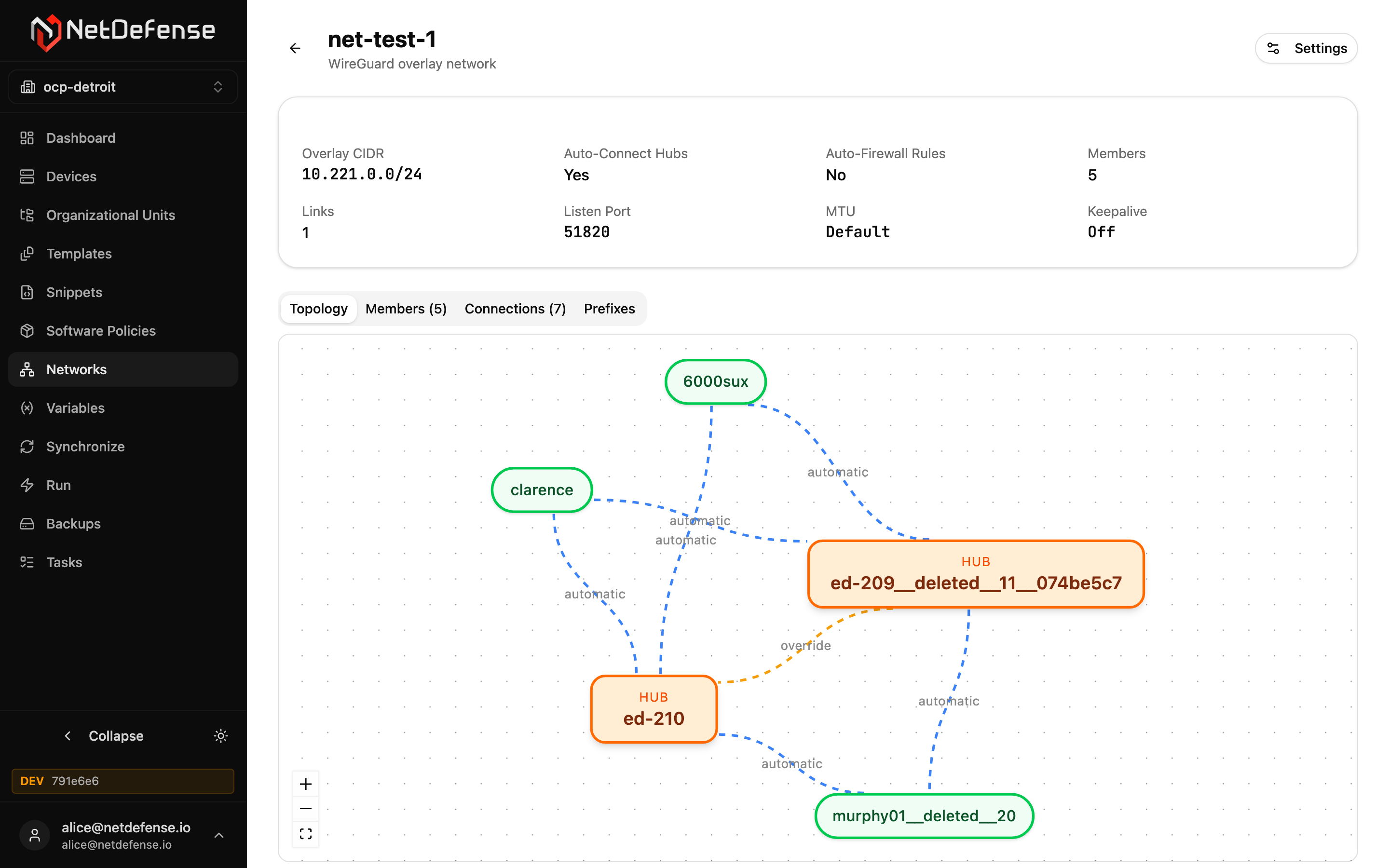
The header has the network’s name and a Settings button (edits the metadata set during creation, minus the immutable CIDR).
The summary strip lists the eight key fields at a glance: CIDR, auto-connect, auto-firewall, members, links, listen port, MTU, keepalive.
Below it, four tabs:
- Topology — a graph view of the mesh. HUB members get an orange ring, SPOKE members get a green ring. Solid lines are explicit links; dashed lines are automatic edges from Auto-Connect or Auto-Firewall.
- Members (N) — table of joined devices with their overlay IP, role (HUB/SPOKE), and listen port. Add or remove members here.
- Connections (N) — table of explicit peer-to-peer links you’ve defined. Add a link to force a peering that auto-connect wouldn’t create on its own.
- Prefixes — the additional CIDRs each member announces to the mesh (typically a LAN behind the firewall).