Run
The Run page is where you tell devices to do something now that isn’t a configuration change — ping a host, reboot the agent, install or reload a plugin. It targets one device, several devices, an OU, or the entire organization, and lets you defer execution to a later time. Read the conceptual background in Run Command.
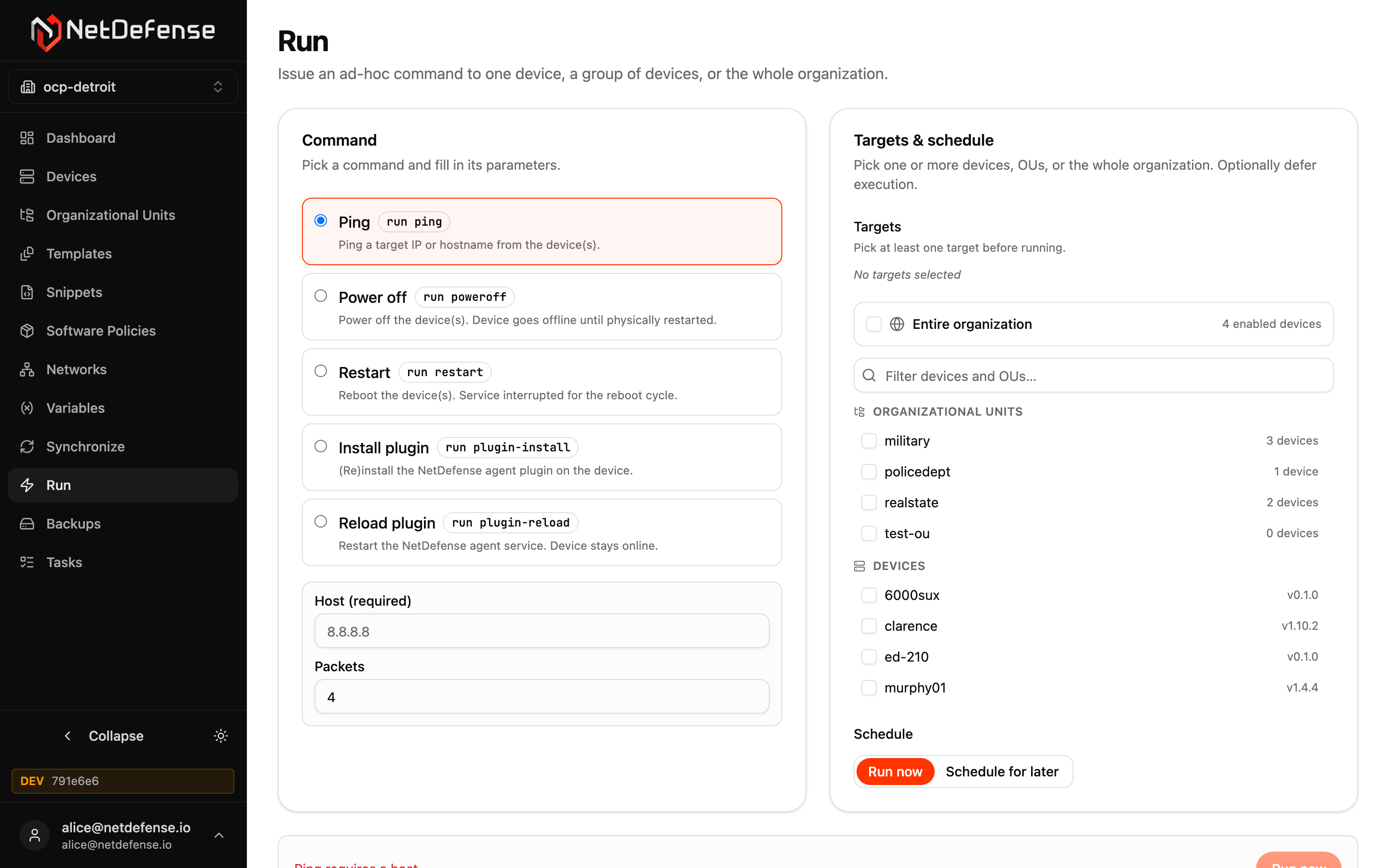
How the page is organized
Section titled “How the page is organized”The page is split into two panels.
Command (left)
Section titled “Command (left)”Pick one command, then fill in its parameters. The current commands are:
| Command | What it does |
|---|---|
| Ping | run ping — ICMP from the device(s) to a host or IP. Useful as a quick reachability probe. |
| Power off | run poweroff — the device shuts down. It goes offline until physically restarted. |
| Restart | run restart — reboots the device. Service is interrupted for the reboot cycle. |
| Install plugin | run plugin-install — (re)installs the NDAgent plugin on the device. |
| Reload plugin | run plugin-reload — restarts the NDAgent service without rebooting. |
| Firmware upgrade | run firmware-upgrade — upgrades OPNsense firmware. Select minor or major mode; for minor upgrades, enable No reboot to apply only reboot-free packages and defer base/kernel to a later window. Use Dry run to preview the package set before committing. |
Each command has its own parameter fields below the picker (host + packet count for Ping; nothing for Restart; etc.).
Targets & schedule (right)
Section titled “Targets & schedule (right)”Choose one or more targets — Entire organization, an OU, or specific devices — using the filter and the checkbox list. The summary at the top updates as you pick (e.g. 2 devices selected).
At the bottom of the panel:
- Run now — dispatches the command immediately. Each affected device gets a new task that you can follow on Tasks.
- Schedule for later — opens a date/time picker. The page shows the resolved fire time in your local timezone (the same time is stored in UTC under the hood). Scheduled tasks sit in
PENDINGuntil the dispatcher activates them.
Run actions don’t change persistent configuration — they’re one-off operations against the device. To roll out a configuration change use Synchronize.