Synchronize
Editing a snippet, template, or variable doesn’t change anything on a firewall by itself — the change sits in the control plane until you sync it. The Synchronize page is the central place to push the computed configuration to any or every device in an organization. Read about the delivery pipeline in Sync & Delivery.
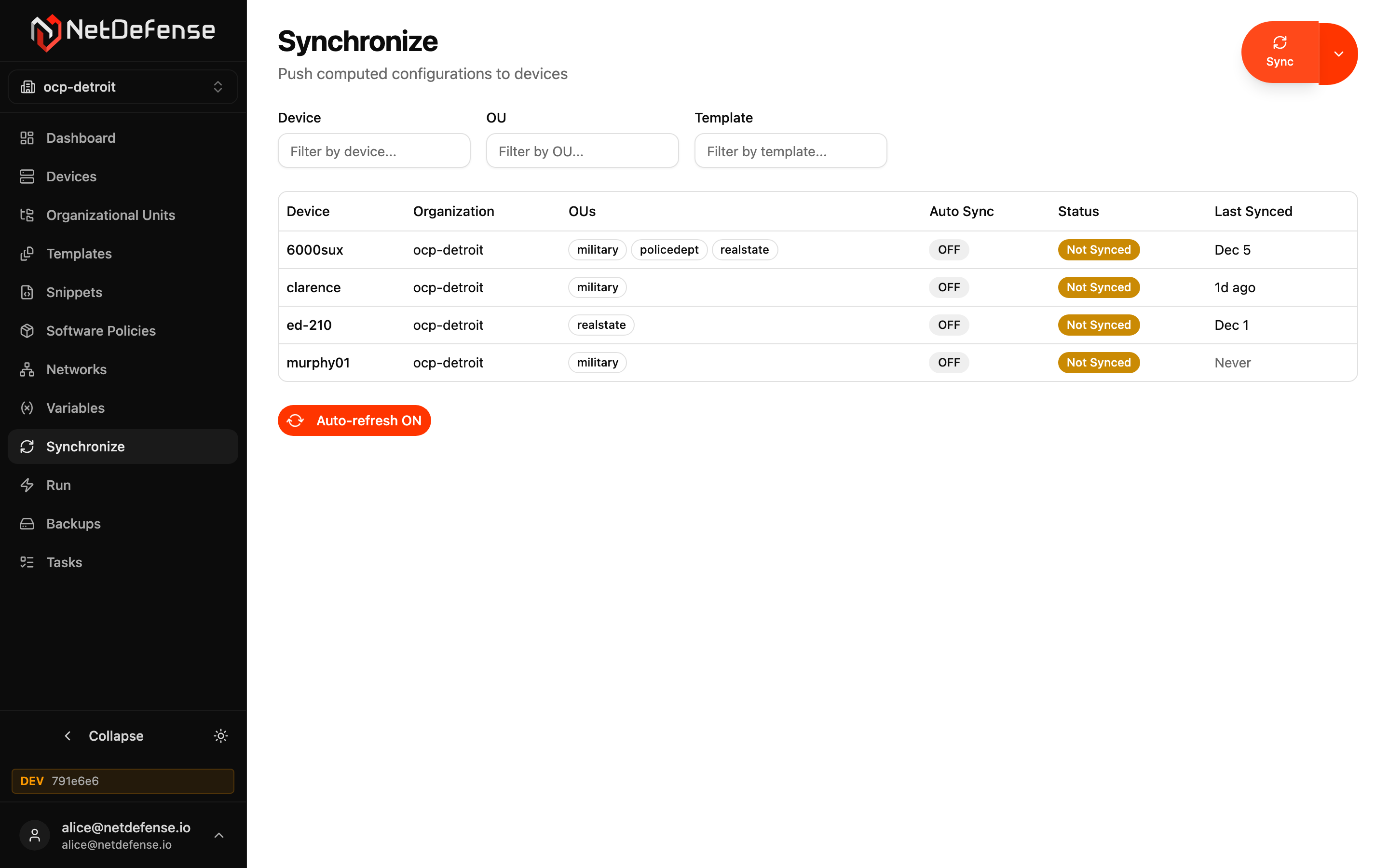
What the table shows
Section titled “What the table shows”Every device in the active organization, with:
| Column | Meaning |
|---|---|
| Device | Name of the device. |
| Organization | Always the active organization (shown for clarity in switching workflows). |
| OUs | The OUs the device belongs to. |
| Auto Sync | Per-device toggle. When on, NetDefense automatically syncs whenever a templates/snippets/variables change touches the device. When off, syncs only run when triggered manually. |
| Status | Synced, Not Synced (drift exists), or the last sync’s outcome. |
| Last Synced | Timestamp of the last successful sync, or Never. |
| Drift | Whether the device’s running configuration matches what NetDefense last delivered. Values: IN_SYNC, DRIFT, NEVER_SYNCED, UNKNOWN, ERROR. See Drift Detection. |
Filter the table by device name, OU, template, or drift status using the filter bar at the top.
Triggering a sync
Section titled “Triggering a sync”Three ways to push:
- Sync (top-right, with split-button arrow) — runs a sync on every device shown in the table (after filters). The split arrow exposes Sync filtered vs Sync all.
- Per-row Sync — the … menu on each device row syncs just that device. (Same outcome as clicking Sync on the device’s detail page.)
- Per-OU Sync — open the OU and click Sync OU in the header. Useful for promoting a change to a whole department in one batch.
Auto-refresh ON (bottom-left of the table) keeps the status column live while you’re watching a sync wave roll out — handy when you’ve just pushed and want to see each device flip from Pending to Synced without reloading.
A sync produces a task. Click into a task to see the device’s full execution log if a sync fails.
Filter builder and device preview
Section titled “Filter builder and device preview”Before triggering a sync, use the filter bar to narrow the target set by device name, OU, template, or drift status. Click Preview to see the exact list of matching devices before committing — useful for verifying that a filtered sync will reach the right firewalls.
The preview is available for both immediate runs and scheduled syncs. Once you’re satisfied with the selection, choose Sync to run immediately or pick a schedule from the dropdown to attach it as a recurring operation.
Scheduling a sync
Section titled “Scheduling a sync”To make a sync recur automatically, select a schedule from the schedule dropdown in the sync form. This creates a scheduled task that runs the filtered sync on every tick of the named schedule. Manage active recurring syncs from the Scheduled Specs tab on the Tasks page.