Variables
A NetDefense variable is a named value that snippets reference by {{name}}. Each variable has a default at the organization level and can be overridden at the template, OU, or device level — the more specific scope wins. Variables can also be marked secret, in which case their values are stored encrypted and never displayed in plain text. The concept overview is in Variables.
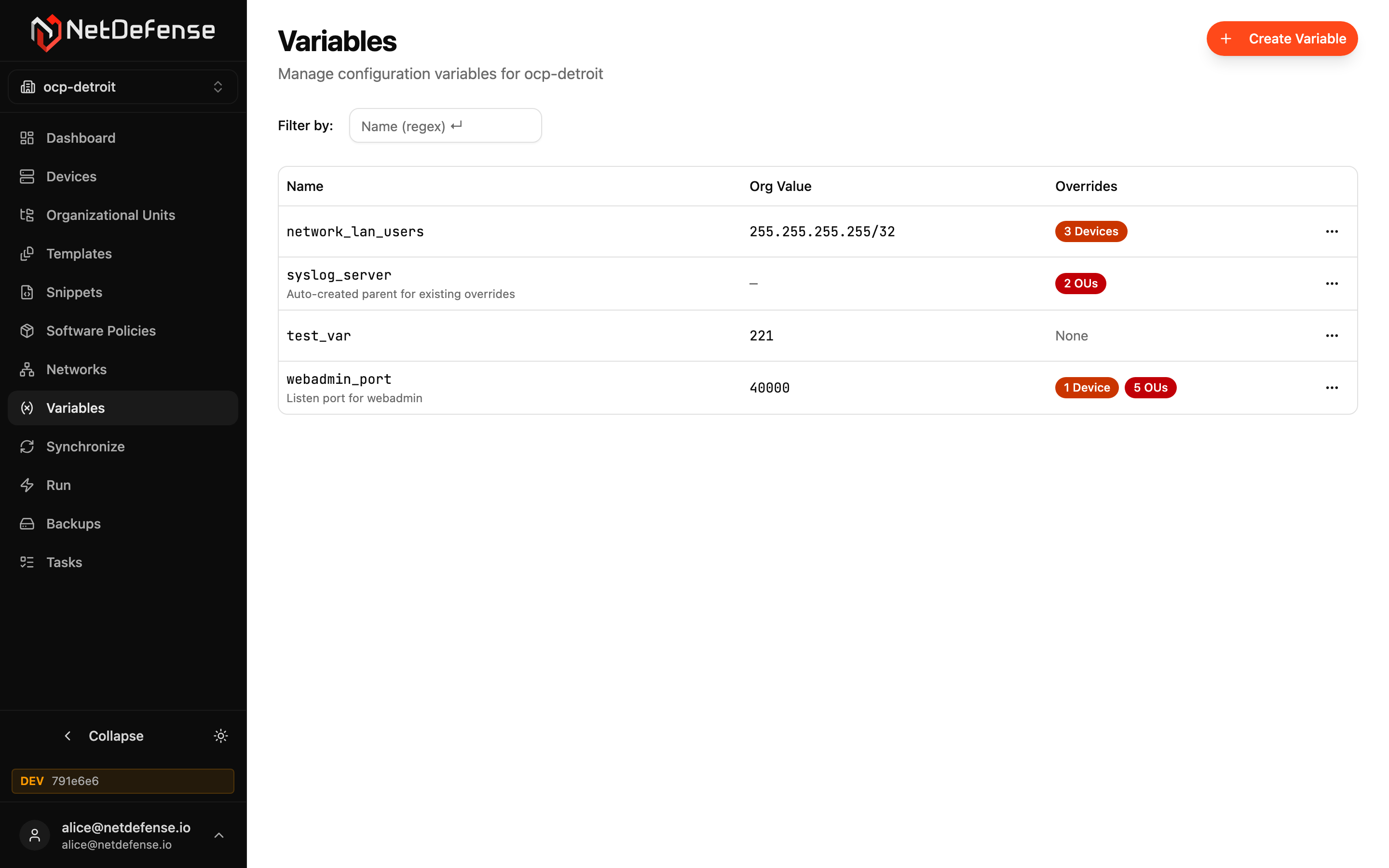
Variables list
Section titled “Variables list”Each row is one variable:
| Column | Meaning |
|---|---|
| Name | Used as {{name}} in snippet content. Click to open the variable. |
| Org Value | The organization-level default. Dashes (—) mean no org default is set — the variable only exists because something at a lower scope overrides it. |
| Overrides | Badges showing how many devices and OUs override this variable. Click the badge to open the override sheet. |
Secret variables show their org value as a masked placeholder rather than the raw string.
The filter bar above the table accepts a name regex.
The … menu on each row has Edit, Manage Overrides, and Delete.
Create a variable
Section titled “Create a variable”+ Create Variable in the top-right opens the form. You provide:
- Name — must be unique in the organization.
- Type — text, number, IP, port, etc.; the type informs validation when you set values.
- Secret — toggle on to store the value encrypted and prevent display in cleartext. Secrets show as
••••••on every override sheet and detail page. - Description — optional, but recommended for shared organizations.
- Value — the default at the organization scope. Leave blank to make the variable a “marker” that only exists at lower scopes.
Overrides
Section titled “Overrides”A variable’s value at sync time is decided by walking from most-specific to least-specific:
- Device override (set on the device’s detail page).
- OU override (set on the OU’s detail page).
- Template override (set on the template’s detail page).
- Organization default (set on the variable itself).
Open a variable’s override sheet from the badges in the Overrides column to see who’s overriding it at each scope, edit values, or remove an override. Removing all overrides at every scope falls back to the org default.