Tasks
Every action NetDefense takes on a device becomes a task — sync, restart, ping, plugin install, backup. Tasks are the audit trail and the debugging surface. The Tasks page has two tabs: Task History (individual executions) and Scheduled Specs (recurring task definitions).
Task History
Section titled “Task History”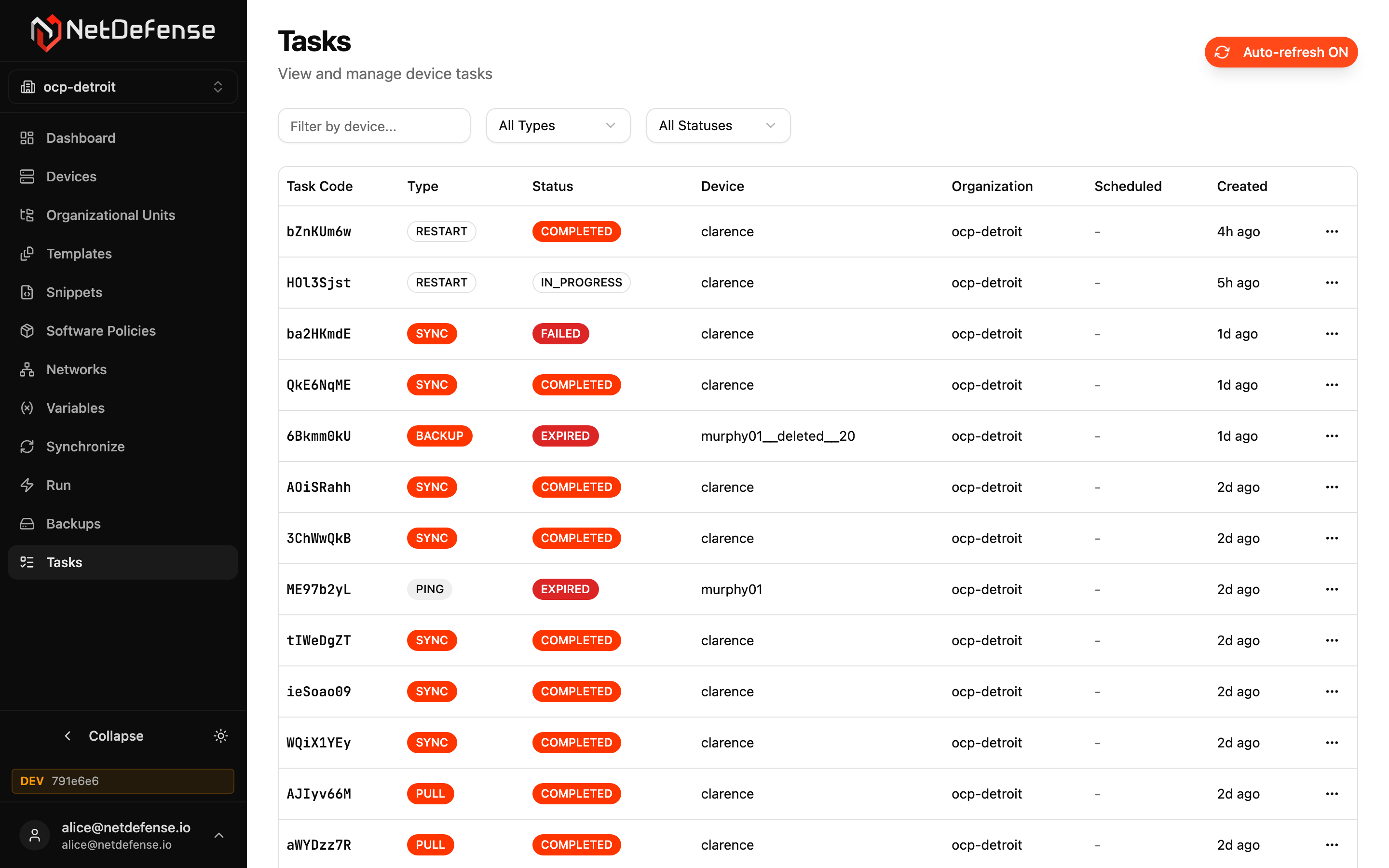
Each row is one task. The columns:
| Column | Meaning |
|---|---|
| Task Code | Short opaque identifier. Click to open the task. |
| Type | SYNC, RESTART, PING, PULL, PUSH, BACKUP, PLUGIN_INSTALL, FIRMWARE_UPGRADE, etc. |
| Status | PENDING (waiting to run), IN_PROGRESS, COMPLETED, FAILED, or EXPIRED (the device never came back online before the task’s expiry). |
| Device | The device the task ran against (or the special __deleted__ suffix for devices removed mid-task). |
| Organization | Always the active one. |
| Scheduled | When a deferred task is set to fire; — for immediate tasks. |
| Created | When the task was added to the queue. |
The filter bar above the table accepts a device-name substring, a type dropdown (multi-select), and a status dropdown (multi-select) — select multiple types or statuses to broaden the filter.
Auto-refresh ON (top-right) keeps the list live — useful when you’re watching a fan-out (e.g. sync on the whole organization) progress.
Task detail
Section titled “Task detail”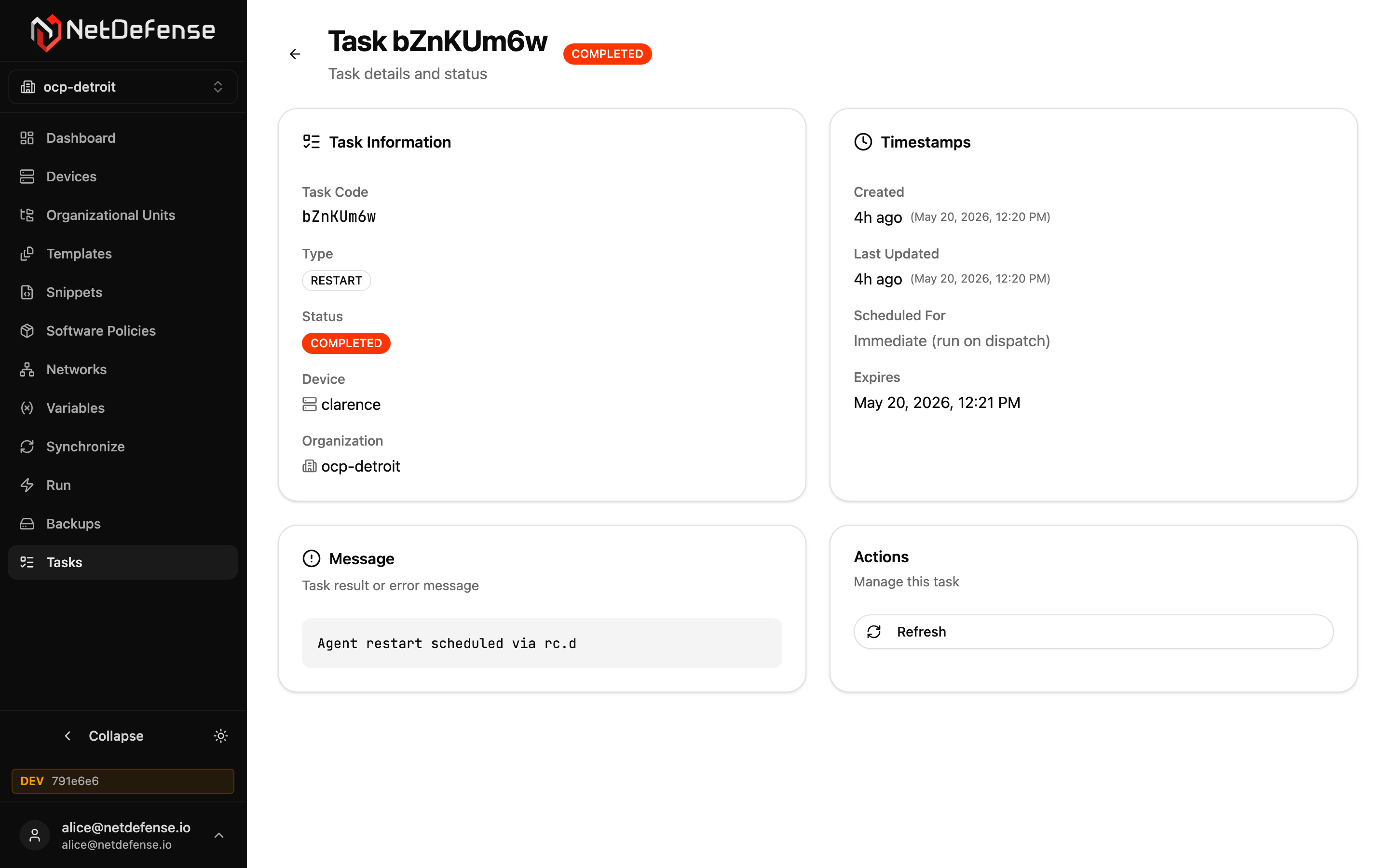
The header shows the task code and a colour-coded status badge. Below it, four cards:
Task Information — task code, type, status, target device, and organization.
Timestamps — when the task was created and last updated, when it was scheduled to fire (Immediate if it ran on dispatch), and when it expires if the device never picks it up.
Message — the agent’s result string. For a successful restart this is something like Agent restart scheduled via rc.d; for failures it’s the underlying error message — start here when debugging.
Actions — task-level operations. Refresh re-fetches the task to show updated state without reloading the page. Long-running tasks may also expose a Cancel action while they’re still PENDING.
Tasks are immutable after they finish — you can’t edit history. If a task failed and you want to retry, use the action that created it (re-sync, re-run, etc.) to issue a fresh task.
Scheduled Specs
Section titled “Scheduled Specs”The Scheduled Specs tab lists every recurring task in the active organization — the operations that run automatically on a named schedule.
Each row shows:
| Column | Meaning |
|---|---|
| Code | Unique identifier for this scheduled task. |
| Type | The operation type: SYNC, RESTART, BACKUP, PLUGIN_INSTALL, FIRMWARE_UPGRADE, etc. |
| Schedule | The named schedule driving this task. Click to view or edit the schedule. |
| Target | The resolved target: an OU name, a device name, or the organization. |
| Enabled | Toggle to pause or resume this specific recurring task without touching the schedule. |
Use the Remove action (kebab menu) to permanently delete a scheduled task. Removing it stops all future executions; the schedule itself remains and can be reused.
See Scheduled Tasks for the full concept and NDCLI commands.